ExamVeda
Login
Home
61
Perimeter of a rectangular field is 160 metres and the difference between its two adjacent sides is 48 metres. The side of a square field, having the same area as that of the rectangle, is :
Discuss
Answer & Solution
Answer: Option D
Solution:
Let the sides of the rectangle be x metres and (x + 48) metres
Then,
$$\eqalign{ & 2\left( {x + x + 48} \right) = 160 \cr & \Rightarrow 4x + 96 = 160 \cr & \Rightarrow 4x = 64 \cr & \Rightarrow x = 16 \cr} $$
So, sides of the rectangle are 16 metres and 64 metres
Area of the rectangle :
= (16 × 64) m2
= 1024 m2
Area of the square = 1024 m2
∴ Side of the square :
= $$\sqrt {1024} $$  m
= 32 metres
62
The length and breadth of a square are increased by 40% and 30% respectively. The area of the resulting rectangle exceeds the area of the square by :
Discuss
Answer & Solution
Answer: Option D
Solution:
Let length = $$l$$ metres and breadth = b metres
Then, original area = (lb) m2
New length :
$$\eqalign{ & = \left( {140\% {\text{ of }}l} \right)m \cr & = \left( {\frac{{140}}{{100}} \times l} \right)m \cr & = \frac{{7l}}{5}m \cr} $$
New breadth :
$$\eqalign{ & = \left( {130\% {\text{ of }}b} \right)m \cr & = \left( {\frac{{130}}{{100}} \times b} \right)m \cr & = \frac{{13l}}{{10}}m \cr} $$
New area :
$$\eqalign{ & = \left( {\frac{{7l}}{5} \times \frac{{13b}}{{10}}} \right){m^2} \cr & = \left( {\frac{{91lb}}{{50}}} \right){m^2} \cr} $$
Increase :
$$\eqalign{ & = \left( {\frac{{91lb}}{{50}} - lb} \right) \cr & = \frac{{41}}{{50}}lb \cr} $$
∴ Increase % :
$$\eqalign{ & = \left( {\frac{{41}}{{50}} \times lb \times \frac{1}{{lb}} \times 100} \right)\% \cr & = 82\% \cr} $$
63
The length, breadth and height of the room are in the ratio 3 : 2 : 1. The breadth and height of the room are halved and length of the room is doubled. The area of the four walls of the room will :
Discuss
Answer & Solution
Answer: Option D
Solution:
Let the length, breadth and height of the room be 3x, 2x and x respectively.
Area of 4 walls :
$$\eqalign{ & = 2\left( {l + b} \right) \times h \cr & = 2\left( {3x + 2x} \right) \times x \cr & = 10{x^2} \cr} $$
New length = 6x
New breadth = x
New height = $$\frac{x}{2}$$
New area of four walls :
$$\eqalign{ & = \left[ {2\left( {6x + x} \right)\frac{x}{2}} \right] \cr & = 7{x^2} \cr} $$
Decrease in area :
$$\eqalign{ & = \left( {10{x^2} - 7{x^2}} \right) \cr & = 3{x^2} \cr} $$
∴ Decrease% :
$$\eqalign{ & = \left( {\frac{{3{x^2}}}{{10{x^2}}} \times 100} \right)\% \cr & = 30\% \cr} $$
64
The ratio of bases of two triangles is x : y and that of their areas is a : b. Then the ratio of their corresponding altitudes will be :
Discuss
Answer & Solution
Answer: Option C
Solution:
$$\eqalign{ & \frac{a}{b} = \frac{{\frac{1}{2}x \times {h_1}}}{{\frac{1}{2}y \times {h_2}}}bx{h_1} = ay{h_2} \cr & \Leftrightarrow \frac{{{h_1}}}{{{h_2}}} = \frac{{ay}}{{bx}} \cr} $$
\[\left[ \begin{gathered} {\text{Ratio of areas}} = \frac{a}{b}{\text{ }} \hfill \\ {\text{Ratio of base}} = x:y \hfill \\ \end{gathered} \right]\]

$${\text{Hence, }}{h_1}:{h_2} = ay:bx$$
65
A vertical rod of height 33 metres is bent to form a semi-circular shape so that the top touches the ground. The distance between the top head and the base on the ground is :
Discuss
Answer & Solution
Answer: Option C
Solution:
$$\eqalign{ & \pi R = 33 \cr & \Rightarrow R = \left( {\frac{{33 \times 7}}{{22}}} \right) \cr & \Rightarrow R = \left( {\frac{{21}}{2}} \right)m \cr} $$
∴ Required distance = 2R = 21 m
66
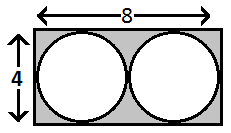
What is the area of the shaded region ?
Area mcq question image
Discuss
Answer & Solution
Answer: Option B
Solution:
Radius of each circle = 2 units
Area of the shaded region :
$$=$$ Area of the rectangle $$-$$ Area of two circles
$$\eqalign{ & = \left[ {\left( {8 \times 4} \right) - 2 \times \pi {{\left( 2 \right)}^2}} \right]\text{sq. units} \cr & = \left( {32 - 8\pi } \right)\text{sq. units} \cr} $$
67
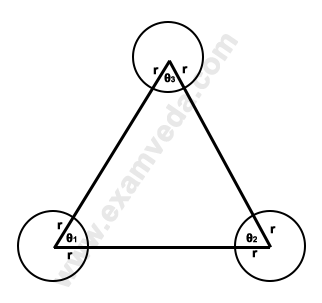
Three equal circles are described with vertices of the triangles as centres. If the radius of each circle is r, the sum of areas of the portions of the circles intercepted in a triangle is :
Discuss
Answer & Solution
Answer: Option D
Solution:
Area mcq solution image
We have :
Required area :
$$\eqalign{ & = \frac{{\pi {r^2}{\theta _1}}}{{360}} + \frac{{\pi {r^2}{\theta _2}}}{{360}} + \frac{{\pi {r^2}{\theta _3}}}{{360}} \cr & = \frac{{\pi {r^2}}}{{360}}\left( {{\theta _1} + {\theta _2} + {\theta _3}} \right) \cr & = \frac{{\pi {r^2} \times 180}}{{360}} \left[ {\because {\theta _1} + {\theta _2} + {\theta _3} = 180^ \circ} \right] \cr & = \frac{{\pi {r^2}}}{2}Or = \frac{1}{2}\pi {r^2} \cr} $$
68
The total surface area of a right circular cylinder with radius of the base 7 cm and height 20 cm, is :
Discuss
Answer & Solution
Answer: Option D
Solution:
Radius and height of a right circular cylinder is 7 cm and 20 cm respectively
Total surface area of right circular cylinder :
$$\eqalign{ & = 2\pi rh + 2\pi r^2 \cr & = 2\pi r\left( {h + r} \right) \cr & = 2 \times \frac{{22}}{7} \times 7\left( {20 + 7} \right) \cr & = 2 \times 22 \times 27 \cr & = 1188\,sq.\,cm \cr} $$
69
The area of a rectangle field is 52000 m2 . This rectangular area has been drawn on a map to the scale 1 cm to 100 m. The length is shown as 3.25 cm on the map. The breadth of the rectangular field is :
Discuss
Answer & Solution
Answer: Option B
Solution:
Length of the field :
$$\eqalign{ & = \left( {3.25 \times 100} \right)m \cr & = 325\,m \cr} $$
∴ Breadth of the field :
$$\eqalign{ & = \left( {\frac{{52000}}{{325}}} \right)m \cr & = 160\,m \cr} $$
70
If the length of a rectangle is increased by 10% and its breadth is decreased by 10%, the change in its area will be :
Discuss
Answer & Solution
Answer: Option B
Solution:
Let the original length and breadth of the rectangle be $$l$$ and b respectively.
Then,
Original area = $$lb$$
New length :
$$ = 110\% {\text{ of }}l = \frac{{11}}{{10}}l$$
New breadth :
$$ = 90\% {\text{ of }}b = \frac{{9}}{{10}}b$$
New area :
$$\eqalign{ & = \left( {\frac{{11}}{{10}}l \times \frac{{9}}{{10}}}b \right) \cr & = \frac{{99}}{{100}}lb \cr} $$
Decrease in area :
$$\eqalign{ & = \left( {lb - \frac{{99}}{{100}}}lb \right) \cr & = \frac{{lb}}{{100}} \cr} $$
∴ Decrease % :
$$\eqalign{ & = \left( {\frac{{lb}}{{100}} \times \frac{1}{{1b}} \times 100} \right)\% \cr & = 1\% \cr} $$