
ExamVeda
Login
Home
11
The least number which must be added to the greatest number of 4 digits in order that the sum may be exactly divisible by 307 is:
Discuss
Answer & Solution
Answer: Option A
Solution:
The greatest 4 digit number = 9999
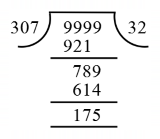
Number System mcq question image
∴ Number to be added = 307 - 175 = 132
12
If 7-digit number 678p37q is divisible by 75 and p is not a composite, then the values of p and q are:
Discuss
Answer & Solution
Answer: Option C
Solution:
678p37q is divisible by 75 means it will be divisible by 25 & 3
If 678p37q is divisible by 25 then q = 5
Now check for 3
6 + 7 + 8 + 3 + 7 + q + p
$$ = \frac{{36 + p}}{3}$$
p = 3, 6, 9
Hence, option C is correct
13
What is the sum of first 20 terms of the following series?
1 × 2 + 2 × 3 + 3 × 4 + 4 × 5 + . . . . . . . .
Discuss
Answer & Solution
Answer: Option A
Solution:
$$\eqalign{ & {\text{Sum,}} \cr & {S_n} = \frac{{n\left( {n + 1} \right)\left( {n + 2} \right)}}{3} \cr & {S_{20}} = \frac{{20 \times 21 \times 22}}{3} \cr & = 140 \times 22 \cr & = 3080 \cr} $$
14
How many numbers are there from 400 to 700 in which the digit 6 occurs exactly twice?
Discuss
Answer & Solution
Answer: Option A
Solution:
From 400 to 500 = only 466
From 500 to 600 = only 566
From 600 to 700 ⇒ 606, 616, 626, 636, 646, 656, 676, 686, 696 and 660, 661, 662, 663, 664, 665, 667, 668, 669
Total numbers = 20
15
Which one of the following is the minimum value of the sum of two integers whose products is 24?
Discuss
Answer & Solution
Answer: Option D
Solution:
Let number are a, b
ab = 24 = 2 × 2 × 2 × 3
\[\begin{array}{*{20}{c}} {{\text{Possible}}\left( {a,\,b} \right){\text{pair of}}}&{{\text{Sum}}\left( {a + b} \right)} \\ {\left( {2,\,12} \right)}&{14} \\ {\left( {4,\,6} \right)}&{10} \\ {\left( {8,\,3} \right)}&{11} \\ {\left( {24,\,1} \right)}&{25} \end{array}\]
Then minimum value of the sum = 10
16
A four-digit pin, say 'abcd', of a lock has different non-zero digits. The digits satisfy b = 2a, c = 2b, d = 2c. The pin is divisible by . . . . . . . .
Discuss
Answer & Solution
Answer: Option C
Solution:
abcd
Let a = 1
1 2 4 8
÷ 2 ✓
÷ 3 ✓
÷ 13 ✓
17
The real number to be added to 13851 to get a number which is divisible by 87 is:
Discuss
Answer & Solution
Answer: Option D
Solution:
By hit and trial method = 13851 + 69 = 13920
Which is divisible by 87.
18
Weight of a bucket when filled fully with water is 17 kg. If the weight of the bucket when half filled with water is 13.5 kg, what is the weight of empty bucket?
Discuss
Answer & Solution
Answer: Option C
Solution:
$$\eqalign{ & {\text{Bucket}} + {\text{full water}} = {\text{17 kg}} \cr & \underline {{\text{Bucket}} + \frac{1}{2}{\text{water}} = 13.5{\text{ kg}}} \to \left( {{\text{Subtract}}} \right) \cr & \,\,\,\,\,\,\,\,\,\,\,\,\,\,\,\,\,\,\,\,\,\frac{1}{2}{\text{water}} = 3.5\,{\text{kg}} \cr & \therefore {\text{Water}} = 2 \times 3.5 = 7\,{\text{kg}} \cr & \therefore {\text{Weight of empty bucket}} \cr & = 17 - 7 = 10{\text{ kg}} \cr} $$
19
5349 is added to 3957. Then 7062 is subtracted from the sum. The result is not divisible by
Discuss
Answer & Solution
Answer: Option C
Solution:
5349 + 3957 - 7062 = 2244
This is not divisible by 7.
20
If each of the two numbers 516 and 525 are divided by 6, the remainders are R1 and R2 respectively. What is the value of $$\frac{{{{\text{R}}_1} + {{\text{R}}_2}}}{{{{\text{R}}_2}}}?$$
Discuss
Answer & Solution
Answer: Option D
Solution:
Given:
Two numbers 516 and 525 are divided by 6, the remainders are R1 and R2 respectively.
Concept used:
If a number in the form of (b - 1)n is divided by b
Then,
Remainder = 1 if n is even number
Remainder = (b - 1) if n is an odd number
Calculation:
$$\eqalign{ & {5^{16}} = {\left( {6 - 1} \right)^{16}} \cr & {\text{So, remainder}} = \frac{{{{\left( {6 - 1} \right)}^{16}}}}{6} = 1\,{\text{i}}{\text{.e}}{\text{.,}}\,{{\text{R}}_{\text{1}}} \cr & {\text{Again, }}{5^{25}} = {\left( {6 - 1} \right)^{25}} \cr & {\text{So, remainder}} = \frac{{{{\left( {6 - 1} \right)}^{25}}}}{6} = \left( {6 - 1} \right) = 5\,{\text{i}}{\text{.e}}{\text{.,}}\,{{\text{R}}_{\text{2}}} \cr & {\text{Now,}} \cr & \frac{{{{\text{R}}_1} + {{\text{R}}_2}}}{{{{\text{R}}_2}}} = \frac{{1 + 5}}{5} = \frac{6}{5} \cr & \therefore {\text{Required answer is }}\frac{6}{5} \cr} $$