ExamVeda
Login
Home
11
Consider the following statements :
I. Every equilateral triangle is necessarily an isosceles triangle.
II. Every right-angled triangle is necessarily an isosceles triangle.
III. A triangle in which one of the median is perpendicular to the side it meets, is necessarily an isosceles triangle.
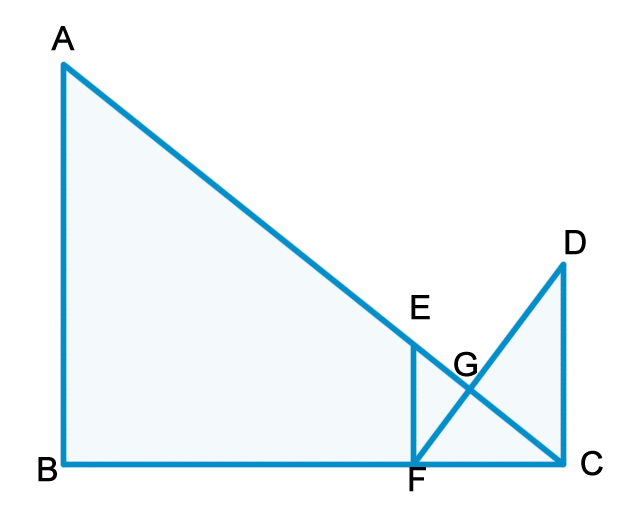
The correct statements are:
Discuss
Answer & Solution
Answer: Option C
Solution:
Every equilateral triangle is necessarily an isosceles triangle.
A triangle in which one of the median is perpendicular to the side it meets, is necessarily an isosceles triangle.

12
Consider the following statements :
I. Three sides of a triangle are equal to three sides of another triangle, then the triangles are congruent.
II. If three angles of a triangle are respectively equal to three angles of another triangle, then the two triangles are congruent.
Of these statements :
Discuss
Answer & Solution
Answer: Option B
Solution:
Statement II is false, as in case of equilateral triangles of different sides of the triangle are similar.
13
In ΔABC, AD ⊥ BC, then
Discuss
Answer & Solution
Answer: Option A
Solution:
In ΔADC
AB2 = AD2 + BD2 - - - - - - - (1)
In Right angled Δ ACD,
AC2 = AD2 + BD2 - - - - - - - (2)
By (1) - (2)
AB2 - AC2 = BD2 - CD2
AB2 - BD2 = AC2 - CD2
14
In the adjoining figure AB, EF and CD are parallel lines. Given that GE = 5 cm, GC = 10 cm and DC = 18 cm, then EF is equal to:
mcq questions triangle Aptitude12
Discuss
Answer & Solution
Answer: Option D
Solution:
In ΔGEF and ΔGCD, we have
∠EFG = ∠GCD (Alternative angle)
∠EFG = ∠CGD (Vertically opposite angles)
ΔGEF ~ ΔGCD
Thus,
$$\eqalign{ & \frac{{{\text{GE}}}}{{{\text{CG}}}} = \frac{{{\text{EF}}}}{{{\text{CD}}}} \cr & {\text{or, }}\frac{5}{{10}} = \frac{{{\text{EF}}}}{{18}} \cr & {\text{or,}}\,{\text{EF}} = 9\,{\text{cm}} \cr} $$
15
A triangle cannot be drawn with the following three sides
Discuss
Answer & Solution
Answer: Option B
Solution:
Addition any two side of a triangle is always greater then another side then only triangle formation is possible
lets e.g a, b, c is a side of a triangle then a + b > c, b + c > a, c + a > b
So option B is not satisfying the condition 3 + 4 ≯ 8
16
The in-radius of an equilateral triangle is of length 3 cm. Then the length of each of its medians is
Discuss
Answer & Solution
Answer: Option D
Solution:
According to question,
Triangles mcq solution image
AO = IR = Circumradius
DO = Ir = Inradius = 3 cm
Median AD = 3 units
1 unit = 3 cm
3 units = 3 × 3 = 9 cm
∴ AD = 9 cm
17
The sides of a triangle are in the ratio 3 : 4 : 6. The triangle is:
Discuss
Answer & Solution
Answer: Option C
Solution:
According to question,
Let sides of the triangle be 3x, 4x, 6x
Now check the square of biggest side and sum of square of two smallest side and check which is greater.
∴ (3x)2 + (4x)2 < (6x)2
⇒ 25x2 < 36x2
∴ The triangle will be obtuse angled triangle.
18
In ΔABC, AD is the internal bisector of ∠A, meeting the side BC at D. If BD = 5 cm, BC = 7.5 cm, then AB : AC is
Discuss
Answer & Solution
Answer: Option A
Solution:
According to question,
Triangles mcq solution image
By internal bisector property
$$\eqalign{ & \frac{{AB}}{{AC}} = \frac{{BD}}{{DC}} \cr & \frac{{AB}}{{AC}} = \frac{5}{{2.5}} \cr & \frac{{AB}}{{AC}} = \frac{2}{1} \cr & \therefore AB:AC = 2:1 \cr} $$
19
If the circumradius of an equilateral triangle be 10 cm, then the measure of its in-radius is
Discuss
Answer & Solution
Answer: Option A
Solution:
According to question,
Circumradius of an equilateral triangle
IR = 10 cm
AO = IR = 10 cm
DO = Ir = ?
Triangles mcq solution image
2 units → 10 cm
1 unit → 5 cm
∴ DO = Ir = 5 cm
20
I is the incentre of ΔABC, ∠ABC = 60° and ∠ACB = 50°, Then ∠BIC is
Discuss
Answer & Solution
Answer: Option B
Solution:
According to question,
Triangles mcq solution image
BI and CI are the angle bisector
∴ ∠CBI = 30° and ∠BCI = 25°
In ΔBIC
∠CBI + ∠BCI + ∠BIC = 180°
30° + 25° + ∠BIC = 180°
∠BIC = 180° - 55°
∴ ∠BIC = 125°