ExamVeda
Login
Home
11
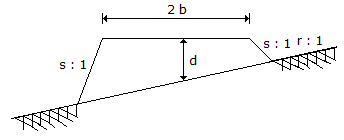
The area of the cross-section of a road fully in banking shown in the given figure, is
Estimating and Costing mcq question image
Discuss
Answer & Solution
Answer: Option A
No explanation is given for this question. Let's Discuss on Board
12
A cement concrete road is 1000 m long, 8 m wide and 15 cm thick over the sub-base of 10 cm thick gravel. The box cutting in road crust is
Discuss
Answer & Solution
Answer: Option D
Solution:
We're asked to find the volume of box cutting needed for a concrete road. Think of "box cutting" as the amount of soil we need to remove (excavate) to create space for the road.

The road is made of two layers:
1. A 15 cm thick concrete layer.
2. A 10 cm thick gravel sub-base layer.

Box cutting is all about how much earth you need to remove, so we only care about the final dimensions of the road profile. So, we need to consider both layers (concrete and gravel) to determine the total depth of the excavation.

1. Calculate the total thickness:
The total thickness is 15 cm (concrete) + 10 cm (gravel) = 25 cm.
We need to convert this to meters: 25 cm = 0.25 m

2. Calculate the volume:
Volume is calculated by: Length x Width x Height (or Thickness in this case)
Length = 1000 m
Width = 8 m
Thickness = 0.25 m
Volume = 1000 m x 8 m x 0.25 m = 2000 m3

Therefore, the correct answer is Option D: 2000 m3
13
The concrete work for the following part of the building of specified thickness is measured in square meters
Discuss
Answer & Solution
Answer: Option D
Solution:
The question asks: When do we measure concrete work in square meters (m²) for a part of a building if it has a "specified thickness"?

Normally, concrete is measured in cubic meters (m³) because it's a 3D material (length x width x thickness). But sometimes, when the concrete part is like a flat sheet (very wide and long, but relatively thin) and its thickness is already decided and fixed (for example, 10 cm or 15 cm), it's easier and standard practice in civil engineering to measure just its area in square meters (m²). This is common for thin, flat concrete structures.

Let's look at the options:

Option A: Roof slabs
Roof slabs are flat concrete sheets that form the roof of a building. They always have a specified thickness (e.g., 125 mm or 150 mm). Since they are thin and cover a large area, their concrete work is typically measured by their area in square meters (m²).

Option B: Floors
Similar to roof slabs, floor slabs (like the ground floor or upper floors) are also flat concrete surfaces with a specified thickness. For example, a 100 mm thick floor slab. Therefore, the concrete for floors is also measured by its area in square meters (m²).

Option C: Wall panels
Concrete wall panels, especially precast ones or thin dividing walls, also come with a specified thickness. If you have a concrete wall that is, say, 150 mm thick throughout, its concrete work will be measured by its area (height x length) in square meters (m²).

Since all these parts of a building (roof slabs, floors, and wall panels) are relatively thin, cover a large area, and have a specified and uniform thickness, their concrete work is measured in square meters (m²) for estimation and costing purposes.

Therefore, the correct answer is Option D: All the above.

Key takeaway: When concrete elements are flat, cover a large area, and have a clearly specified and constant thickness, they are measured in square meters (m²) for simplicity and standard practice in estimating and costing.
14
The expected out turn of cement concrete 1 : 2 : 4 per mason per day is
Discuss
Answer & Solution
Answer: Option D
No explanation is given for this question. Let's Discuss on Board
15
The expected out turn of half brick partition wall per mason per day is
Discuss
Answer & Solution
Answer: Option D
No explanation is given for this question. Let's Discuss on Board
16
The measurement is made in square metre in case of
Discuss
Answer & Solution
Answer: Option D
No explanation is given for this question. Let's Discuss on Board
17
The measurement is made for stone work in square metre in case of
Discuss
Answer & Solution
Answer: Option D
Solution:
This question is about understanding how different types of stone work are measured in Civil Engineering, specifically in Estimating and Costing. The way we measure helps us calculate the amount of material needed and the cost.

There are three main ways to measure stone work:
1. Cubic Metre (m³): Used for large, solid stone structures where thickness, width, and height are all significant. Think of a thick stone wall, a solid stone pillar, or foundations.
2. Square Metre (m²): Used for flat, surface applications where the thickness is either very small, uniform, or specified separately. Think of covering a wall with stone, flooring, or paving.
3. Linear Metre (m): Used for long, slender stone pieces with a uniform cross-section, like a decorative strip along a wall or a small cap on a parapet.

The question asks when stone work is measured in square metres (m²).

Let's look at the options:

Option A: Wall facing
Wall facing means applying a thin layer of stone material to the surface of an existing wall for decoration or protection. Since you are covering a flat surface, you primarily need to know the area you are covering. The thickness of the stone facing is usually small and standard, or specified separately. Therefore, wall facing is definitely measured in square metres (m²).

Option B: Columns, lintels, copings
While these elements can sometimes be made of solid, thick stone (which would be measured in m³), they can also involve stone work that is measured in m²:
- Columns: If you are applying a thin stone cladding or facing to a column, you would measure the surface area of the column that is covered.
- Lintels: These are horizontal structural elements above openings like doors or windows. If a lintel is made of a thin stone slab (rather than a thick, solid block), or if you are applying a stone finish to its surface, it can be measured by its surface area.
- Copings: These are protective caps on top of walls, parapets, or ledges. If the coping is a wide, relatively thin stone slab, its measurement would be based on its surface area (length multiplied by its width).
So, there are specific scenarios where stone work for columns, lintels, and copings can be measured in square metres (m²).

Option C: Building work
This option is too general. "Building work" includes all kinds of stone work, some measured in m³, some in m², and some in m. It doesn't specifically answer when m² is used.

Option D: (A) and (B) of the above
Since both Wall facing (A) and certain types of stone work for Columns, lintels, and copings (B) are appropriately measured in square metres, this is the correct answer.

18
As per Indian Standard Specifications, the peak discharge for domestic purposes per capita per minute, is taken
Discuss
Answer & Solution
Answer: Option D
No explanation is given for this question. Let's Discuss on Board
19
Pick up the correct statement in case of water supply.
Discuss
Answer & Solution
Answer: Option D
No explanation is given for this question. Let's Discuss on Board
20
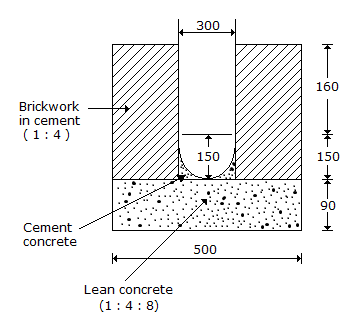
The cost of the earthwork in excavation for the surface drain of cross-section shown in the given figure for a total length of 5 metres @ Rs. 450% cum, is
Estimating and Costing mcq question image
Discuss
Answer & Solution
Answer: Option C
No explanation is given for this question. Let's Discuss on Board