ExamVeda
Login
Home
31
The condition of refrigerant as it leaves the compressor in a vapour compression system is
Discuss
Answer & Solution
Answer: Option D
Solution:
The condition of refrigerant as it leaves the compressor in a vapour compression system is Superheated vapour
32
The temperature of ammonia after compression in a vapour compression system is
Discuss
Answer & Solution
Answer: Option C
Solution:
The temperature of ammonia after compression in a vapour compression system is 70 to 110°C
33
In a flooded evaporator refrigerator, an accumulator at suction of compressor is used to
Discuss
Answer & Solution
Answer: Option A
Solution:
In a flooded evaporator refrigerator, an accumulator at suction of compressor is used to Collect liquid refrigerant and prevent it from going to compressor
34
A refrigerant compressor is used to
Discuss
Answer & Solution
Answer: Option D
Solution:
A refrigerant compressor is used to:
- Raise the pressure of the refrigerant
- Raise the temperature of the refrigerant
- Circulate the refrigerant through the refrigerating system
35
A reversible engine has ideal thermal efficiency of 30%. When it is used as a refrigerating machine with all other conditions unchanged, the coefficient of performance will be
Discuss
Answer & Solution
Answer: Option B
Solution:
C.O.P. is reciprocal of efficiency of heat engine.
C.O.P. = $$\frac{1}{{0.3}}$$
= 3.33 = C.O.P. of heat engine.
Now,
C.O.P. of refrigerator = C.O.P. of heat engine - 1
= 3.33 - 1
= 2.33.
36
In a domestic refrigerator, a capillary tube controls the flow of refrigerant from the
Discuss
Answer & Solution
Answer: Option D
Solution:
Correct Answer: Option D — Condenser to the evaporator

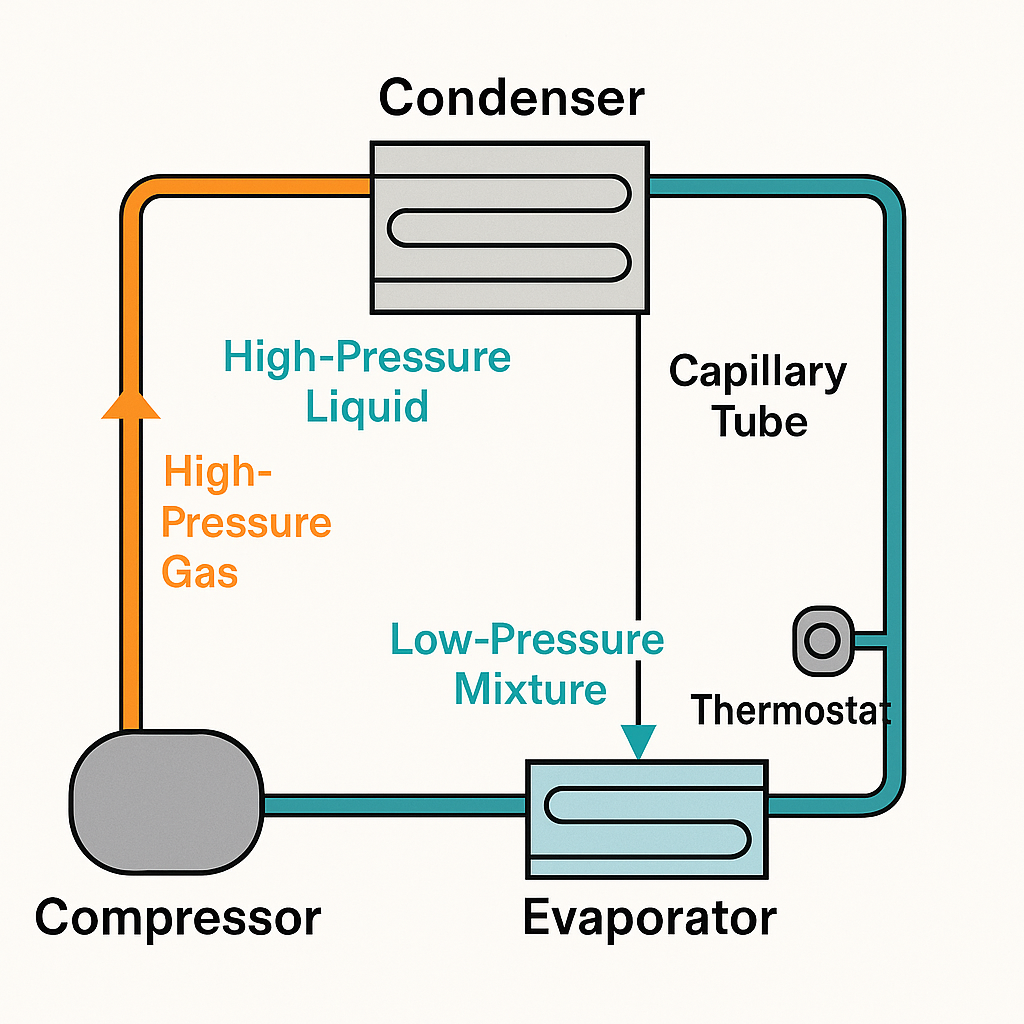
Key Idea: In domestic refrigerators, the capillary tube itself is the expansion device. It directly connects the condenser outlet (high-pressure liquid) to the evaporator inlet (low-pressure region) and creates the required pressure drop to enable refrigeration.

Cycle Overview (Flow Path): Compressor → Condenser → Capillary Tube → Evaporator → back to Compressor

What Happens Physically:

After compression, the refrigerant is a hot, high-pressure gas.

In the condenser, it rejects heat to surroundings and becomes a high-pressure liquid.

This liquid enters the capillary tube (a long, narrow tube). Due to its small internal diameter and length, it imposes a flow resistance, causing a substantial pressure drop from condenser pressure to evaporator pressure.

Because of the pressure drop, a portion of the liquid flashes (evaporates) and its temperature falls close to the saturation temperature corresponding to the low evaporator pressure.

The low-pressure mixture then enters the evaporator, where it absorbs heat from the refrigerator compartment and fully evaporates, producing the desired cooling.

Why Capillary Tube Is Used in Domestic Refrigerators:

• It is simple, inexpensive, and reliable (no moving parts).

• It provides automatic flow regulation to some extent: when load decreases, evaporator pressure drops, mass flow reduces through the restriction, helping maintain stable operation.

• It suits the small, steady loads typical of household refrigerators and works well with on–off (cycling) control of the compressor by a thermostat.

Why the Other Options Are Incorrect:

• Option A (Expansion valve to the evaporator): An expansion valve is a different device. Most domestic units do not use a thermostatic expansion valve; they use a capillary tube. Hence, this connection description does not apply to capillary-tube systems.

• Option B (Evaporator to the thermostat): The thermostat is a control/sensing device, not part of the refrigerant piping. Refrigerant does not flow to the thermostat; it merely senses temperature and switches the compressor.

• Option C (Condenser to the expansion valve): Again assumes the presence of a separate expansion valve. In a domestic refrigerator, the capillary tube itself performs the expansion, so the correct connection is directly to the evaporator.

Conclusion: The capillary tube controls the flow of refrigerant from the condenser to the evaporator by creating the necessary pressure drop, making Option D the correct choice. Refrigeration and Air Conditioning mcq solution image
37
A vapour absorption refrigeration system
Discuss
Answer & Solution
Answer: Option B
Solution:
A vapour absorption refrigeration system Gives quiet operation
38
A refrigeration system
Discuss
Answer & Solution
Answer: Option A
Solution:
Refrigeration is the process of cooling a space, substance, or system to lower and/or maintain its temperature below the ambient one (while the removed heat is rejected at a higher temperature). In other words, refrigeration means artificial (human-made) cooling.
39
A thermostatic expansion valve in a refrigeration system
Discuss
Answer & Solution
Answer: Option A
Solution:
A thermostatic expansion valve in a refrigeration system Ensures the evaporator completely filled with refrigerant of the load
40
Aqua ammonia is used as refrigerant in the following type of refrigeration system
Discuss
Answer & Solution
Answer: Option D
Solution:
Aqua ammonia is used as refrigerant in the Absorption type of refrigeration system