
ExamVeda
Login
Home
21
The oxidation reaction lines of metals/nonmetals parallel to x- axis in Ellingham diagram is corresponds to
Discuss
Answer & Solution
Answer: Option A
No explanation is given for this question. Let's Discuss on Board
22
What is the temperature range for CO where it can act as reducing agent for iron oxide reduction
Discuss
Answer & Solution
Answer: Option A
No explanation is given for this question. Let's Discuss on Board
23
The activity of pure hydrogen gas at 1000°C and 5 atm. pressure.
Discuss
Answer & Solution
Answer: Option D
No explanation is given for this question. Let's Discuss on Board
24
If two system P & Q are in thermal equi librium with a third system M, then P and Q will also be in thermal equilibrium with each other. This is following . . . . . . . . law of thermodynamics.
Discuss
Answer & Solution
Answer: Option D
No explanation is given for this question. Let's Discuss on Board
25
As the temperature increases, the solubility of gas in molten metal . . . . . . . . at constant pressure
Discuss
Answer & Solution
Answer: Option A
No explanation is given for this question. Let's Discuss on Board
26
A chemical reaction whose rate does not depend on concentration of reactants is called
Discuss
Answer & Solution
Answer: Option A
No explanation is given for this question. Let's Discuss on Board
27
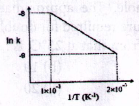
If k is the rate constant for a reaction and T is the absolute temperature in the given figure, the activation energy for the reaction is . . . . . . . . J/K mole.
Metallurgical Thermodynamics and Kinetics mcq question image
Discuss
Answer & Solution
Answer: Option D
No explanation is given for this question. Let's Discuss on Board
28
The erder of a chemical reaction
Discuss
Answer & Solution
Answer: Option B
No explanation is given for this question. Let's Discuss on Board
29
In reaction equilibria occuring between pure condensed phases and a gas phase, the equilibrium constant, K
Discuss
Answer & Solution
Answer: Option A
No explanation is given for this question. Let's Discuss on Board
30
When one mole of the substance is completely burnt in oxygen. The heat evolve is known
Discuss
Answer & Solution
Answer: Option A
No explanation is given for this question. Let's Discuss on Board