
ExamVeda
Login
Home
51
The Daltons law of partial pressure can be written as
Discuss
Answer & Solution
Answer: Option A
No explanation is given for this question. Let's Discuss on Board
52
When two phases α and β in an alloy are in thermodynamic equilibrium, then
Discuss
Answer & Solution
Answer: Option D
No explanation is given for this question. Let's Discuss on Board
53
Consider an ideal solution of component A and B. The entropy of mixing per mole of an alloy containing 50 wt% B, is
Discuss
Answer & Solution
Answer: Option A
No explanation is given for this question. Let's Discuss on Board
54
The hydrogen content of steel in equilibrium with hydrogen gas at 1 bar pressure is 28 ppm at some temperature. Hydrogen content in the metal at the same temperature gets reduced at 1 ppm, when the equilibrium PH2 changes to . . . . . . . . bar.
Discuss
Answer & Solution
Answer: Option B
No explanation is given for this question. Let's Discuss on Board
55
For an ideal gas, Cp - Cv is
Discuss
Answer & Solution
Answer: Option A
No explanation is given for this question. Let's Discuss on Board
56
At 1200°C, the standard Gibbs energy of thermal decomposition of one mole of wustite into Fe and O2 is 168 J.
The corresponding dissociation pressure (in atm.) is
Discuss
Answer & Solution
Answer: Option B
No explanation is given for this question. Let's Discuss on Board
57
Uphill diffusion means diffusion from
Discuss
Answer & Solution
Answer: Option A
No explanation is given for this question. Let's Discuss on Board
58
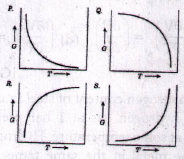
Select the correct plot of Gibbs free energy (G) Vs. Temperature (T) for a single component system from the following:
Metallurgical Thermodynamics and Kinetics mcq question image
Discuss
Answer & Solution
Answer: Option B
No explanation is given for this question. Let's Discuss on Board
59
The part of the universe excluding the system is known as
Discuss
Answer & Solution
Answer: Option A
No explanation is given for this question. Let's Discuss on Board
60
Reaction between A and B results in an intermediate complex AB* which leads to the final product AB as, A + B ⟶ AB* ⟶ AB. Collision rate theory views the rate as dependent on
Discuss
Answer & Solution
Answer: Option A
No explanation is given for this question. Let's Discuss on Board