ExamVeda
Login
Home
61
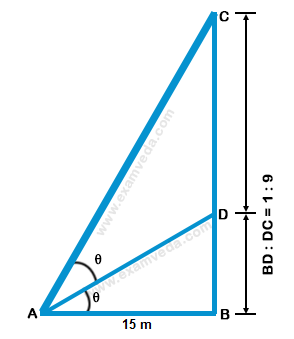
A vertical pole fixed to the ground is divided in the ratio 1 : 9 by a mark on it with lower part shorter than the upper part. If the two parts subtend equal angles at a place on the ground, 15 m away from the base of the pole, what is the height of the pole?
Discuss
Answer & Solution
Answer: Option A
Solution:
Height and Distance mcq solution image
Let CB be the pole and point D divides it such that BD : DC = 1 : 9
Given that AB = 15 m
Let the the two parts subtend equal angles at point A such that ∠ CAD = ∠ BAD = $$\theta $$
From "Angle Bisector Theorem", we have
$$\frac{{BD}}{{DC}} = \frac{{AB}}{{AC}}$$
$$ \Rightarrow \frac{1}{9} = \frac{{15}}{{AC}}$$     [∵ BD : DC = 1 : 9 and AB = 15(given)]
$$ \Rightarrow AC = 15 \times 9\,{\text{m}}\,......\left( {eq:1} \right)$$
$${\text{From}}\,{\text{the}}\,{\text{right}}\,\Delta ABC,$$
$$CB = \sqrt {A{C^2} - A{B^2}} $$     (∵ Pythagorean theorem)
$$ = \sqrt {{{\left( {15 \times 9} \right)}^2} - {{15}^2}} $$     [∵AC=15 × 9(eq : 1) and AB=15 m(given)]
$$\eqalign{ & = \sqrt {{{15}^2} \times {9^2} - {{15}^2}} \cr & = \sqrt {{{15}^2}\left( {{9^2} - 1} \right)} \cr & = \sqrt {{{15}^2} \times 80} \cr & = \sqrt {{{15}^2} \times 16 \times 5} \cr & = 15 \times 4 \times \sqrt 5 \cr & = 60\sqrt 5 \,{\text{m}} \cr} $$
62
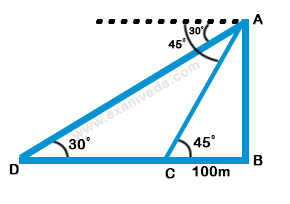
A man is watching from the top of a tower a boat speeding away from the tower. The boat makes an angle of depression of 45° with the man's eye when at a distance of 100 metres from the tower. After 10 seconds, the angle of depression becomes 30°. What is the approximate speed of the boat, assuming that it is running in still water?
Discuss
Answer & Solution
Answer: Option A
Solution:
Height and Distance mcq solution image
Consider the diagram shown above.
Let AB be the tower. Let C and D be the positions of the boat
Then, ∠ ACB = 45°, ∠ ADC = 30°, BC = 100 m
$$\eqalign{ & \tan {45^ \circ } = \frac{{AB}}{{BC}} \cr & \Rightarrow 1 = \frac{{AB}}{{100}} \cr & \Rightarrow AB = 100\,......\left( {eq:1} \right) \cr} $$
$$\tan {30^ \circ } = \frac{{AB}}{{BD}}$$
$$ \Rightarrow \frac{1}{{\sqrt 3 }} = \frac{{100}}{{BD}}$$     (∵ Substituted the value of AB from equation 1)
$$ \Rightarrow BD = 100\sqrt 3 $$
$$\eqalign{ & CD = \left( {BD - BC} \right) \cr & \,\,\,\,\,\,\,\,\,\,\, = \left( {100\sqrt 3 - 100} \right) \cr & \,\,\,\,\,\,\,\,\,\,\, = 100\left( {\sqrt 3 - 1} \right) \cr} $$
It is given that the distance CD is covered in 10 seconds.
i.e., the distance $$100\left( {\sqrt 3 - 1} \right)$$     is covered in 10 seconds.
$$\eqalign{ & {\text{Required}}\,{\text{speed}} \cr & = \frac{{{\text{Distance}}}}{{{\text{Time}}}} \cr & = \frac{{100\left( {\sqrt 3 - 1} \right)}}{{10}} \cr & = 10\left( {1.73 - 1} \right) \cr & = 7.3\,{\text{meter/seconds}} \cr & = 7.3 \times \frac{{18}}{5}\,{\text{km/hr}} \cr & = 26.28\,{\text{km/hr}} \cr} $$
63
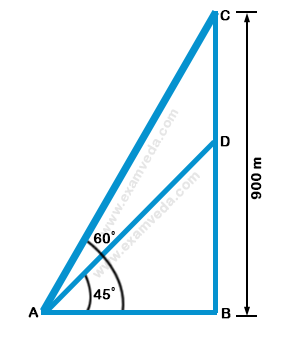
An aeroplane when 900 m high passes vertically above another aeroplane at an instant when their angles of elevation at same observing point are 60° and 45° respectively. Approximately, how many meters higher is the one than the other?
Discuss
Answer & Solution
Answer: Option A
Solution:
Height and Distance mcq solution image
Let C and D be the position of the aeroplanes.
Given that CB = 900 m, ∠ CAB = 60°, ∠ DAB = 45°
$$\eqalign{ & {\text{From}}\,{\text{the}}\,{\text{right}}\,\Delta ABC, \cr & \tan {60^ \circ } = \frac{{CB}}{{AB}} \cr & \sqrt 3 = \frac{{900}}{{AB}} \cr & AB = \frac{{900}}{{\sqrt 3 }} \cr & \,\,\,\,\,\,\,\,\,\, = \frac{{900 \times \sqrt 3 }}{{\sqrt 3 \times \sqrt 3 }} \cr & \,\,\,\,\,\,\,\,\,\, = \frac{{900\sqrt 3 }}{3} \cr & \,\,\,\,\,\,\,\,\,\, = 300\sqrt 3 \cr & {\text{From}}\,{\text{the}}\,{\text{right}}\,\Delta ABD, \cr & \tan {45^ \circ } = \frac{{DB}}{{AB}} \cr & 1 = \frac{{DB}}{{AB}} \cr & DB = AB = 300\sqrt 3 \cr & \cr & {\text{Required}}\,{\text{height}} \cr & = CD \cr & = \left( {CB - DB} \right) \cr & = \left( {900 - 300\sqrt 3 } \right) \cr & = \left( {900 - 300 \times 1.73} \right) \cr & = \left( {900 - 519} \right) \cr & = 381\,{\text{m}} \cr} $$
64
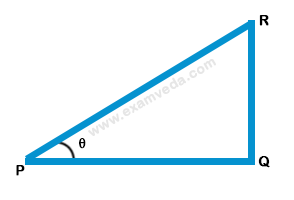
The angle of elevation of the sun, when the length of the shadow of a tree is equal to the height of the tree, is:
Discuss
Answer & Solution
Answer: Option C
Solution:
Height and Distance mcq solution image
Consider the diagram shown above where QR represents the tree and PQ represents its shadow
$$\eqalign{ & {\text{We}}\,{\text{have}},\,QR = PQ \cr & {\text{Let}}\,\angle QPR = \theta \cr} $$
$$\tan \theta = \frac{{QR}}{{PQ}} = 1$$     (since QR = PQ)
$$ \Rightarrow \theta = {45^ \circ }$$
i.e., required angle of elevation = 45°
65
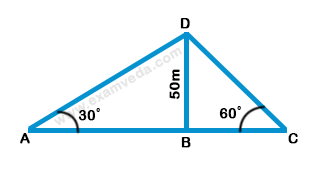
Two persons are on either sides of a tower of height 50 m. The persons observers the top of the tower at an angle of elevation of 30° and 60°. If a car crosses these two persons in 10 seconds, what is the speed of the car?
Discuss
Answer & Solution
Answer: Option A
Solution:
Height and Distance mcq solution image
Let BD be the tower and A and C be the positions of the persons.
Given that BD = 50 m, ∠ BAD = 30°, ∠ BCD = 60°
$$\eqalign{ & {\text{From}}\,{\text{the}}\,{\text{right}}\,\Delta \,ABD, \cr & \tan {30^ \circ } = \frac{{BD}}{{BA}} \cr & \Rightarrow \frac{1}{{\sqrt 3 }} = \frac{{50}}{{BA}} \cr & \Rightarrow BA = 50\sqrt 3 \cr & {\text{From}}\,{\text{the}}\,{\text{right}}\,\Delta CBD, \cr & \tan {60^ \circ } = \frac{{BD}}{{BC}} \cr & \Rightarrow \sqrt 3 = \frac{{50}}{{BC}} \cr & \Rightarrow BC = \frac{{50}}{{\sqrt 3 }} \cr & \,\,\,\,\,\,\,\,\,\,\,\,\,\,\,\,\,\, = \frac{{50 \times \sqrt 3 }}{{\sqrt 3 \times \sqrt 3 }} \cr & \,\,\,\,\,\,\,\,\,\,\,\,\,\,\,\,\,\, = \frac{{50\sqrt 3 }}{3} \cr} $$
Distance between the two persons
$$\eqalign{ & = AC = BA + BC \cr & = 50\sqrt 3 + \frac{{50\sqrt 3 }}{3} \cr & = \sqrt 3 \left( {50 + \frac{{50}}{3}} \right) \cr & = \frac{{200\sqrt 3 }}{3}\,{\text{m}} \cr} $$
i.e., the distance travelled by the car in 10 seconds = $$\frac{{200\sqrt 3 }}{3}\,{\text{m}}$$
$$\eqalign{ & {\text{Speed}}\,{\text{of the car}} = \frac{{{\text{Distance}}}}{{{\text{Time}}}} \cr & = \frac{{\left( {\frac{{200\sqrt 3 }}{3}} \right)}}{{10}} = \frac{{200\sqrt 3 }}{3}\,{\text{m/s}} \cr & = \frac{{200\sqrt 3 }}{3} \times \frac{{18}}{5}\,{\text{km/hr}} \cr & = {\text{24}}\sqrt 3 \,{\text{km/hr}} \cr} $$
66
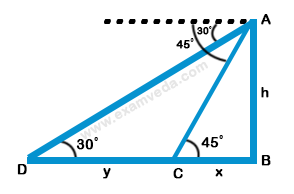
A man on the top of a vertical observation tower observers a car moving at a uniform speed coming directly towards it. If it takes 8 minutes for the angle of depression to change from 30° to 45°, how soon after this will the car reach the observation tower?
Discuss
Answer & Solution
Answer: Option B
Solution:
Height and Distance mcq solution image
Consider the diagram shown above. Let AB be the tower. Let D and C be the positions of the car.
Then, ∠ ADC = 30° , ∠ ACB = 45°
Let AB = h, BC = x, CD = y
$$\eqalign{ & \tan {45^ \circ } = \frac{{AB}}{{BC}} = \frac{h}{x} \cr & \Rightarrow 1 = \frac{h}{x} \cr & \Rightarrow h = x\,......\left( 1 \right) \cr & \tan {30^ \circ } = \frac{{AB}}{{BD}} \cr & \,\,\,\,\,\,\,\,\,\,\,\,\,\,\,\,\,\,\,\, = \frac{{AB}}{{\left( {BC + CD} \right)}} \cr & \,\,\,\,\,\,\,\,\,\,\,\,\,\,\,\,\,\,\,\, = \frac{h}{{x + y}} \cr & \Rightarrow \frac{1}{{\sqrt 3 }} = \frac{h}{{x + y}} \cr & \Rightarrow x + y = \sqrt 3 \,h \cr & \Rightarrow y = \sqrt 3 \,h - x \cr} $$
$$ \Rightarrow y = \sqrt 3 \,h - h$$     (∵ Substituted the value of x from equation 1 )
$$ \Rightarrow y = h\left( {\sqrt 3 - 1} \right)$$
Given that distance y is covered in 8 minutes.
i.e, distance $$h\left( {\sqrt 3 - 1} \right)$$   is covered in 8 minutes.
Time to travel distance x
= Time to travel distance h (∵ Since x = h as per equation 1).
Let distance h is covered in t minutes.
since distance is proportional to the time when the speed is constant, we have
$$\eqalign{ & h\left( {\sqrt 3 - 1} \right) \propto 8\,......\left( {\text{A}} \right) \cr & h \propto t\,..............\left( {\text{B}} \right) \cr & \frac{{\left( {\text{A}} \right)}}{{\left( {\text{B}} \right)}} \Rightarrow \frac{{h\left( {\sqrt 3 - 1} \right)}}{h} = \frac{8}{t} \cr & \Rightarrow \left( {\sqrt 3 - 1} \right) = \frac{8}{t} \cr & \Rightarrow t = \frac{8}{{\left( {\sqrt 3 - 1} \right)}} \cr & \,\,\,\,\,\,\,\,\,\,\, = \frac{8}{{\left( {1.73 - 1} \right)}} \cr & \,\,\,\,\,\,\,\,\,\,\, = \frac{8}{{.73}} \cr & \,\,\,\,\,\,\,\,\,\,\, = \frac{{800}}{{73}}\,{\text{minutes}} \cr & \,\,\,\,\,\,\,\,\,\,\, = 10\frac{{70}}{{73}}\,{\text{minutes}} \cr & \approx {\text{10}}\,{\text{minutes}}\,{\text{57}}\,{\text{seconds}} \cr} $$
67
Two vertical poles are 200 m apart and the height of one is double that of the other. From the middle point of the line joining their feet, an observer finds the angular elevations of their tops to be complementary. Find the heights of the poles.
Discuss
Answer & Solution
Answer: Option B
Solution:
Height and Distance mcq solution image
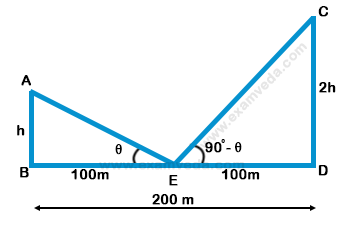
Let AB and CD be the poles with heights h and 2h respectively.
Given that distance between the poles, BD = 200 m
Let E be the middle point of BD,
∠ AEB = $$\theta $$
∠ CED = (90 - $$\theta $$)   (∵ given that angular elevations are complementary)
Since E is the middle point of BD, we have BE = ED = 100 m
$$\eqalign{ & {\text{From}}\,{\text{the}}\,{\text{right}}\,\Delta ABE, \cr & \tan \theta = \frac{{AB}}{{BE}} \cr & \tan \theta = \frac{h}{{100}} \cr & h = 100\tan \theta \,......\left( 1 \right) \cr & {\text{From}}\,{\text{the}}\,{\text{right}}\,\Delta EDC, \cr & \tan\left( {90 - \theta } \right) = \frac{{CD}}{{ED}} \cr} $$
$$\cot \theta = \frac{{2h}}{{100}}$$     $$\left[ {\because \tan \left( {90 - \theta } \right) = \cot \theta } \right]$$
$$\eqalign{ & 2h = 100\cot \theta \,......\left( 2 \right) \cr & \left( 1 \right) \times \left( 2 \right) \cr} $$
$$ \Rightarrow 2{h^2} = {100^2}$$     $$\left[ {\because \tan \theta \times \cot\theta = \tan\theta \times \frac{1}{{\tan \theta }} = 1} \right]$$
$$\eqalign{ & \Rightarrow \sqrt 2 \,h = 100 \cr & \Rightarrow h = \frac{{100}}{{\sqrt 2 }} \cr & \,\,\,\,\,\,\,\,\,\,\,\,\, = \frac{{100 \times \sqrt 2 }}{{\sqrt 2 \times \sqrt 2 }} \cr & \,\,\,\,\,\,\,\,\,\,\,\,\, = 50\sqrt 2 \cr & \,\,\,\,\,\,\,\,\,\,\,\,\, = 50 \times 1.41 \cr & \,\,\,\,\,\,\,\,\,\,\,\,\, = 70.5 \cr & \Rightarrow 2h = 2 \times 70.5 = 141 \cr} $$
i.e. the height of the poles are 70.5 m and 141 m.
68
From the foot and the top of a building of height 230 m, a person observes the top of a tower with angles of elevation of b and a respectively. What is the distance between the top of these buildings if tan a = $$\frac{5}{{12}}$$ and tan b = $$\frac{4}{{5}}$$
Discuss
Answer & Solution
Answer: Option D
Solution:
Height and Distance mcq solution image
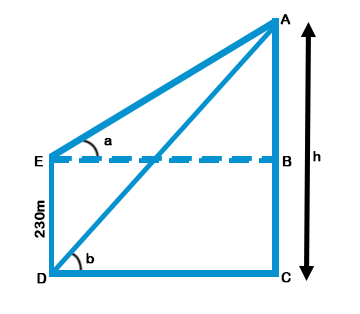
Let ED be the building and AC be the tower.
Given that ED = 230 m, ∠ADC = b, ∠AEB = a
Also given that tan a = $$\frac{5}{{12}}$$ and tan b = $$\frac{4}{{5}}$$
Let AC = h
Required Distance = Distance between the top of these buildings = AE
$$\eqalign{ & {\text{From}}\,{\text{the}}\,{\text{right}}\,\Delta ABE, \cr & \tan \left( a \right) = \frac{{AB}}{{BE}} \cr} $$
$$ \Rightarrow \frac{5}{{12}} = \frac{{\left( {h - 230} \right)}}{{BE}}$$     [∵ tan(a) = $$\frac{5}{{12}}$$ (given), AB = (AC - BC) = (AC - ED) = (h - 230)]
$$\eqalign{ & \Rightarrow BE = \frac{{12\left( {h - 230} \right)}}{5}\,.....\left( 1 \right) \cr & {\text{From}}\,{\text{the}}\,{\text{right}}\,\Delta ACD, \cr & \tan \left( b \right) = \frac{{AC}}{{CD}} \cr} $$
$$ \Rightarrow \frac{4}{5} = \frac{h}{{CD}}$$    [∵ tan(b) = $$\frac{4}{5}$$ (given), AC = h]
$$\eqalign{ & \Rightarrow CD = \frac{{5h}}{4}\,.....\left( 2 \right) \cr & {\text{From}}\,{\text{the}}\,{\text{diagram,}}\,BE = CD \cr} $$
$$ \Rightarrow \frac{{12\left( {h - 230} \right)}}{5} = \frac{{5h}}{4}$$     (from equation 1 & 2)
$$\eqalign{ & \Rightarrow 48h - \left( {4 \times 12 \times 230} \right) = 25h \cr & \Rightarrow 23h = \left( {4 \times 12 \times 230} \right) \cr & \Rightarrow h = \frac{{\left( {4 \times 12 \times 230} \right)}}{{23}} \cr & \,\,\,\,\,\,\,\,\,\,\,\,\, = 480\,{\text{m}}\,......\left( 3 \right) \cr & AB = \left( {AC - BC} \right) \cr} $$
$$\,\,\,\,\,\,\,\,\,\,\,\, = \left( {480 - 230} \right)$$    [∵ Since AC = h = 480 (from 3) and BC = ED = 230 m(given)]
$$\,\,\,\,\,\,\,\,\,\,\,\, = 250\,{\text{m}}$$
In the triangle ABE, tan(a) =$$\frac{5}{{12}}$$ . Let's figure out the value of sin(a) now.
Consider a triangle with opposite side = 5 and adjacent side = 12 such that tan(a) = $$\frac{5}{{12}}$$
$$\eqalign{ & {\text{hypotenuse}} = \sqrt {{5^2} + {{12}^2}} = 13 \cr & {\text{i}}{\text{.e}}{\text{.,}} \cr & \sin \left( a \right) = \frac{{{\text{opposite}}\,{\text{side}}}}{{{\text{hypotenuse}}}} = \frac{5}{{13}} \cr} $$
We have seen that $$\sin \left( a \right) = \frac{5}{{13}}$$
$$\eqalign{ & \Rightarrow \frac{{AB}}{{AE}} = \frac{5}{{13}} \cr & \Rightarrow AE = AB \times \frac{{13}}{5} \cr & = 250 \times \frac{{13}}{5} \cr & = 650\,{\text{m}} \cr} $$

i.e., Distance between the top of the buildings = 650 m
69
From a tower of 80 m high, the angle of depression of a bus is 30°. How far is the bus from the tower?
Discuss
Answer & Solution
Answer: Option B
Solution:
Height and Distance mcq solution image
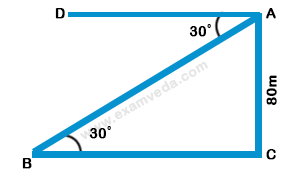
Let AC be the tower and B be the position of the bus.
Then BC = the distance of the bus from the foot of the tower.
Given that height of the tower, AC = 80 m and the angle of depression, ∠DAB = 30°
∠ABC = ∠DAB = 30° (because DA || BC)
$$\eqalign{ & \tan {30^ \circ } = \frac{{AC}}{{BC}} \cr & \Rightarrow \tan {30^ \circ } = \frac{{80}}{{BC}} \cr & \Rightarrow BC = \frac{{80}}{{\tan {{30}^ \circ }}} \cr & \,\,\,\,\,\,\,\,\,\,\,\,\,\,\,\,\,\,\, = \frac{{80}}{{\left( {\frac{1}{{\sqrt 3 }}} \right)}} \cr & = 80 \times 1.73 = 138.4\,{\text{m}} \cr} $$
i.e., Distance of the bus from the foot of the tower = 138.4 m
70
The elevation of the summit of a mountain from its foot is 45°. After ascending 2 km towards the mountain upon an incline of 30°,the elevation changes to 60°. What is the approximate height of the mountain?
Discuss
Answer & Solution
Answer: Option D
Solution:
Height and Distance mcq solution image
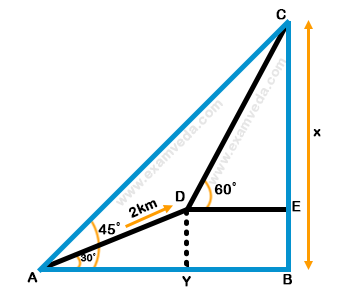
Let A be the foot and C be the summit of a mountain.
Given that ∠CAB = 45°
From the diagram, CB is the height of the mountain. Let CB = x
Let D be the point after ascending 2 km towards the mountain such that AD = 2 km and given that ∠DAY = 30°
It is also given that from the point D, the elevation is 60°
i.e., ∠CDE = 60°
$$\eqalign{ & {\text{From}}\,{\text{the}}\,{\text{right}}\,\Delta ABC, \cr & \tan {45^ \circ } = \frac{{CB}}{{AB}} \cr} $$
$$ \Rightarrow 1 = \frac{x}{{AB}}$$    [∵ CB = x(the height of the mountain)]
$$\eqalign{ & \Rightarrow AB = x\,......\left( 1 \right) \cr & {\text{From}}\,{\text{the}}\,{\text{right}}\,\Delta AYD, \cr & \sin {30^ \circ } = \frac{{DY}}{{AD}} \cr} $$
$$ \Rightarrow \frac{1}{2} = \frac{{DY}}{2}$$    (∵ Given that AD = 2)
$$\eqalign{ & \Rightarrow DY = 1\,.......\left( 2 \right) \cr & \cos {30^ \circ } = \frac{{AY}}{{AD}} \cr} $$
$$ \Rightarrow \frac{{\sqrt 3 }}{2} = \frac{{AY}}{2}$$    (∵ Given that AD = 2)
$$\eqalign{ & \Rightarrow AY = \sqrt 3 \,......\left( 3 \right) \cr & {\text{From}}\,{\text{the}}\,{\text{right}}\,\Delta CED, \cr & \tan {60^ \circ } = \frac{{CE}}{{DE}} \cr} $$
$$ \Rightarrow \tan {60^ \circ } = \frac{{\left( {CB - EB} \right)}}{{YB}}$$     [∵ CE = (CB - EB) and DE = YB)]
$$ \Rightarrow \tan {60^ \circ } = \frac{{\left( {CB - DY} \right)}}{{AB - AY}}$$     [∵ EB = DY and YB = (AB - AY)]
$$ \Rightarrow \tan {60^ \circ } = \frac{{\left( {x - 1} \right)}}{{\left( {x - \sqrt 3 } \right)}}$$
[∵ CB = x, DY = 1(eq:2), AB = x(eq:1) and AY = $${\sqrt 3 }$$ (eq:3)]
$$\eqalign{ & \Rightarrow \sqrt 3 = \frac{{\left( {x - 1} \right)}}{{\left( {x - \sqrt 3 } \right)}} \cr & \Rightarrow x\sqrt 3 - 3 = x - 1 \cr & \Rightarrow x\left( {\sqrt 3 - 1} \right) = 2 \cr & \Rightarrow 0.73x = 2 \cr & \Rightarrow x = \frac{2}{{0.73}} = 2.7 \cr} $$

i.e., the height of the mountain = 2.7 km