
ExamVeda
Login
Home
91
The number π is :
Discuss
Answer & Solution
Answer: Option D
Solution:
Clearly, π is an irrational number
92
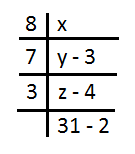
A number is successively divided by 8, 7 and 3 giving residues 3, 4 and 2 respectively and quotient 31. The number is :
Discuss
Answer & Solution
Answer: Option B
Solution:
Number System mcq solution image
z = 3 × 31 + 2 = 95
y = 7 × z + 4 = 7 × 95 + 4 = 669
x = 8 × y + 3 = 8 × 669 + 3 = 5355
∴ Required number = 5355
93
If x - y = 8, then which of the following must be true ?
I. Both x and y are positive.
II. If x is positive, y must be positive.
III. If x is negative, y must be negative.
Discuss
Answer & Solution
Answer: Option D
Solution:
It is given that x - y = 8
I. We may have x = 5 and y = - 3
So, it is not necessary that both x and y are positive.
II. If x positive, then it is not necessary that y is positive, as x = 5 and y = -3
III. If x < 0, then y = x - 8 which is clearly less than 0
So, if x is negative, then y must be negative.
94
? × $$\left( {|a| \times |b|} \right) = - {\text{ ab}}$$
Discuss
Answer & Solution
Answer: Option B
Solution:
Let x × $$\left( {|a| \times |b|} \right) = - {\text{ ab}}$$
Then,
x = $$\frac{{ - \left( {{\text{ab}}} \right)}}{{|ab|}}$$ = -1
95
If you subtract - 1 from + 1, what will be the result ?
Discuss
Answer & Solution
Answer: Option D
Solution:
(+ 1) - (- 1)
= (+ 1 + 1)
= 2
96
All natural numbers and 0 are called the ..... numbers.
Discuss
Answer & Solution
Answer: Option C
Solution:
All natural numbers and 0 are called the whole numbers.
97
For an integer n, n! = n(n - 1) (n - 2) ..... 3.2.1
Then, 1! + 2! + 3! +.....+ 100!, when divided by 5 leaves remainder
Discuss
Answer & Solution
Answer: Option D
Solution:
Every number from 5 onwards is completely divisible by 5
( 5 + 6 + 7 +......+ 100 )       is completely divisible by 5
And,
( 1 + 2 + 3 + 4 )
$$\eqalign{ & = \left( {1 + 2 + 3 \times 2 \times 1 + 4 \times 3 \times 2 \times 1} \right) \cr & = \left( {1 + 2 + 6 + 24} \right) \cr & = 33 \cr} $$
Clearly, 33 when divided by 5 leave a remainder 3
Hence,
( 1 + 2 + 3 + 4 + 5 +......+ 100 )        When divided by 5 leaves a remainder 3
98
A number is multiplied by 11 and 11 is added to the product. If the resulting number is divisible by 13, the smallest original number is = ?
Discuss
Answer & Solution
Answer: Option A
Solution:
Let the required number be x.
Then, $$\frac{11x + 11}{13}$$   = a whole number.
So, (11x + 11) must be divisible by 13
By hit and trial, we get x = 12
Hence, the smallest original number is 12
99
The smallest prime number, that is the fifth term of an increasing arithmetic sequence in which all the four preceding terms are also prime, is -
Discuss
Answer & Solution
Answer: Option B
Solution:
The required arithmetic sequence of five prime numbers is 5, 11, 17, 23, 29 and therefore, the required 5th term is 29
100
Among the following statements, the statement which is not correct is :
Discuss
Answer & Solution
Answer: Option C
Solution:
Every real number is a rational number is not a correct statements.