ExamVeda
Login
Home
21
ABC is an equilateral triangle. Points D, E and F are taken as the mid-point on sides AB, BC, AC respectively, so that AD = BE = CF. Then AE, BF, CD enclosed a triangle which is:
Discuss
Answer & Solution
Answer: Option A
Solution:
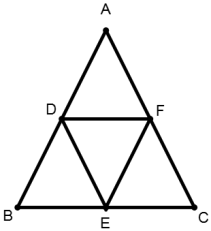
Triangles mcq solution image
Given in question AD = BE = CF
[DB = AF = EC] Because
AB = BC = CA
So, Triangle is equilateral
22
The side BC of a triangle ABC is proceed to D. If ∠ACD = 112° and ∠B = $$\frac{3}{4}$$ ∠A, then the measure of ∠B is:
Discuss
Answer & Solution
Answer: Option C
Solution:
Triangles mcq solution image
Assume, ∠A = x
∴ ∠B = $$\frac{3}{4}$$ x
∠A + ∠B = 112° (∵ sum of two interior angle is equal to the exterior angle of the third angle)
$$\eqalign{ & {x^ \circ } + \frac{3}{4}{x^ \circ } = {112^ \circ } \cr & \frac{{7{x^ \circ }}}{4} = {112^ \circ } \cr & {x^ \circ } = {64^ \circ } \cr & {\text{Hence,}} \cr & \angle B = \frac{3}{4} \times {64^ \circ } \cr & \angle B = {48^ \circ } \cr} $$
23
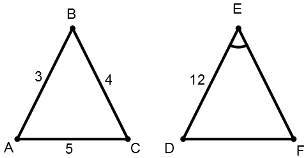
ΔABC is similar to ΔDEF. If the sides of ΔABC, that is AB, BC and CA, are 3, 4 and 5 cms respectively, what would be the perimeter of the ΔDEF, if the side DE measures 12 cms ?
Discuss
Answer & Solution
Answer: Option D
Solution:
Triangles mcq solution image
Perimeter of ΔABC
= 3 + 4 + 5
= 12
$$\eqalign{ & \frac{{{\text{Perimeter}}\,{\text{of}}\,\vartriangle ABC}}{{{\text{Perimeter}}\,{\text{of}}\,\vartriangle DEF}} = \frac{{AB}}{{DE}} \cr & \frac{{12}}{{{\text{Perimeter}}\,{\text{of}}\,\vartriangle DEF}} = \frac{3}{{12}} \cr} $$

Perimeter of ΔDEF = 48 cms
24
In a ΔPQR, ∠Q = 55° and ∠R = 35°. Find the ratio of angles subtended by side QR on circumcenter, incenter and orthocenter of the triangle.
Discuss
Answer & Solution
Answer: Option D
Solution:
Triangles mcq solution image
Circumcenter at the mid point of QR hence angle made by QR
= 2 × 90°
= 180°
Angle made by QR at In center
= 90° + $$\frac{1}{2}$$ × ∠P = 135°
Ortho center is at point 'P'
Hence angle made by QR = 90
Then ration C : I : O
= 180 : 135 : 90
= 4 : 3 : 2
25
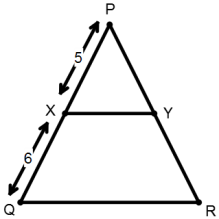
In ΔPQR, straight line parallel to the base QR cuts PQ at X and PR at Y. If PX : XQ = 5 : 6, then XY : QR will be
Discuss
Answer & Solution
Answer: Option A
Solution:
∵ ΔPQR ∼ ΔPXY
Triangles mcq solution image
$$\eqalign{ & \frac{{PX}}{{PQ}} = \frac{{XY}}{{QR}} \cr & \frac{5}{{\left( {5 + 6} \right)}} = \frac{{XY}}{{QR}} \cr & XY:QR = 5:11 \cr} $$
26
In an isosceles triangle ΔABC, AB = AC and ∠A = 80°. The bisector of ∠B and ∠C meet at D. The ∠BDC is equal to.
Discuss
Answer & Solution
Answer: Option C
Solution:
Triangles mcq solution image
∵ AB = AC
   Point D is the incenter
∴ ∠BDC = 90° + $$\frac{1}{2}$$ ∠A
              = 90° + $$\frac{1}{2}$$ × 80°
              = 90° + 40°
              = 130°
27
Let ΔABC and ΔABD be on the same base AB and between the same parallels AB and CD. Then the relation between areas of triangles ABC and ABD will be
Discuss
Answer & Solution
Answer: Option D
Solution:
Triangles mcq solution image
The height of ΔABC and ΔABD are same and have same base.
∴ Area ΔABC = Area ΔABD
28
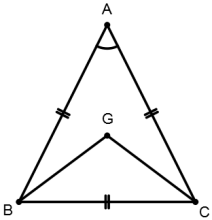
G is the centroid of ΔABC. If AB = BC = AC, then measure of ∠BGC is:
Discuss
Answer & Solution
Answer: Option D
Solution:
Triangles mcq solution image
∴ AB = BC = CA
∠BAC = 60°
So, ∠BGC = 90 + $$\frac{{60}}{2}$$
∠BGC = 120°
29
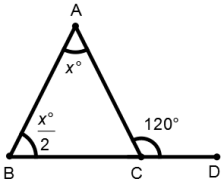
In a ΔABC, BC is extended upto D; ∠ACD = 120°, ∠B = $$\frac{1}{2}$$ ∠A, then ∠A is:
Discuss
Answer & Solution
Answer: Option C
Solution:
Triangles mcq solution image
∠C = 180° - 120° = 60°
∠A + ∠B + ∠C = 180°
∠A + $$\frac{1}{2}$$ ∠A + 60° = 180°
$$\frac{3}{2}$$ ∠A = 120°
∠A = 80°
30
In a triangle ABC, if ∠A + ∠C = 140° and ∠A + 3∠B = 180°, then ∠A is equal to:
Discuss
Answer & Solution
Answer: Option C
Solution:
∠A + ∠B + ∠C = 180°
            (for a triangle)
∠A + ∠C = 140°
then, ∠B = 40°
∠A + 3∠B = 180°
∠A + 120° = 180°
⇒ ∠A = 60°