
ExamVeda
Login
Home
61
At what rate percent per annum of compound interest, will a sum of money become four times of itself in two years ?
Discuss
Answer & Solution
Answer: Option A
Solution:
$$\eqalign{ & {\text{Principal}}\,\,\,\,\,\,\,\,\,\,\,\,\,\,{\text{Amount}} \cr & \,\,\,\,\,\,\,\,\,{\text{1}}\,\,\,\,\,\,\,\,\,\,\,\, \to \,\,\,\,\,\,\,\,\,\,\,\,{\text{4}} \cr & \Rightarrow 4 = 1{\left( {1 + \frac{r}{{100}}} \right)^2} \cr & \Rightarrow 4 = {\left( {1 + \frac{r}{{100}}} \right)^2} \cr & \Rightarrow r = 100\% \cr & \cr & {\text{Alternate}} \cr & {\text{Principal}}\,\,\,\,\,\,\,\,\,\,\,\,{\text{Amount}} \cr & \,\,\,\,\,\,\,\,\,\root 2 \of 1 \,\,\,\,\,\,\,\, \to \,\,\,\,\,\,\,\,\root 2 \of 4 \cr & \,\,\,\,\,\,\,\,\,\,\,1\,\,\,\,\,\,\,\,\,\, \to \,\,\,\,\,\,\,\,\,2 \cr & \Rightarrow {\text{Rate of interest}} \cr & {\text{ = }}\frac{{\left( {2 - 1} \right)}}{1} \times 100 = 100\% \cr} $$
62
On a certain sum of money, the difference between the compound interest for a year, payable half yearly, and the simple interest for a year is Rs. 56. If the rate of interest in both the cases is 16%, then the sum is ?
Discuss
Answer & Solution
Answer: Option C
Solution:
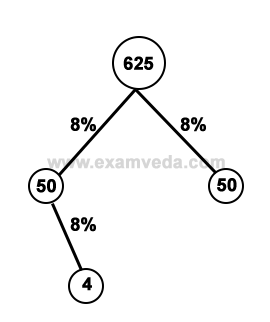
When the money is compounded half yearly the effective rate of interest for 6 months = $$\frac{{16}}{2}$$ = 8% = $$\frac{{2}}{25}$$
Let principal = (25)2 = 625
Compound Interest mcq solution image
⇒ 4 units → 56
⇒ 1 unit → 14
⇒ Principal = 14 × 625 = Rs. 8750
63
On a certain sum of money, the difference between the compound interest for a year payable half yearly, and the simple interest for a year is Rs. 180. If the rate of interest in both the cases is 10%, then the sum is = ?
Discuss
Answer & Solution
Answer: Option B
Solution:
Rate % = 10%,
Time = 1 year
Case (I) : When interest is calculated yearly, Rate = 10%
Case (II) : When interest is calculated half yearly
$$\eqalign{ & \Rightarrow {\text{New rate }}\% = \frac{{10}}{2} = 5\% \cr & {\text{Time = 1}} \times {\text{2}} = {\text{2 years}} \cr & {\text{Effective rate}}\% \cr & {\text{ = 5 + 5 + }}\frac{{5 \times 5}}{{100}} = 10.25\% \cr & {\text{Difference in rates}} \cr & {\text{ = }}\left( {10.25 - 10} \right)\% = 0.25\% \cr & {\text{According to the question,}} \cr & {\text{0}}{\text{.25% of sum = Rs 180}} \cr & {\text{Sum = }}\frac{{180}}{{0.25}} \times 100 \cr & \,\,\,\,\,\,\,\,\,\,\,\,\,\,\, = {\text{Rs. }}72000 \cr} $$
64
The compound interest accrued on an amount of Rs. 25500 at the end of 3 years is Rs. 8440.50. What would be the simple interest accrued on the same amount at the same rate in the same period ?
Discuss
Answer & Solution
Answer: Option D
Solution:
$$\eqalign{ & {\text{Let the rate be R}}\% {\text{ p}}{\text{.a}}{\text{. }} \cr & {\text{then,}} \cr & {\text{25500}}{\left( {1 + \frac{{\text{R}}}{{100}}} \right)^3} \cr & = 25500 + 8440.50 \cr & = 33940.50 \cr} $$
  $$ \Rightarrow {\left( {1 + \frac{{\text{R}}}{{100}}} \right)^3} = \frac{{33940.50}}{{25500}} = $$       $$\frac{{1331}}{{1000}} = $$  $${\left( {\frac{{11}}{{10}}} \right)^3}$$
$$\eqalign{ & \Rightarrow 1 + \frac{{\text{R}}}{{100}} = \frac{{11}}{{10}} \cr & \Rightarrow \frac{{\text{R}}}{{100}} = \frac{1}{{10}} \cr & \Rightarrow {\text{R}} = 10\,\% \cr & S.I. = {\text{R}}s.\left( {\frac{{25500 \times 10 \times 3}}{{100}}} \right) \cr & = {\text{Rs}}{\text{.}}\,7650 \cr} $$
65
The difference between the amount of compound interest and simple interest accrued on an amount of Rs. 26000 at the end of 3 years is Rs. 2994.134. What is the rate of interest p.c.p.a ?
Discuss
Answer & Solution
Answer: Option B
Solution:
Let the R% p.a.
Then,
$$\left[ {26000 \times {{\left( {1 + \frac{{\text{R}}}{{100}}} \right)}^3} - 26000} \right] - $$       $$\left( {\frac{{26000 \times {\text{R}} \times 3}}{{100}}} \right) = $$     $$2994.134$$
$$ \Rightarrow 26000\left[ {{{\left( {1 + \frac{{\text{R}}}{{100}}} \right)}^3} - 1 - \frac{{3{\text{R}}}}{{100}}} \right] = $$        $$2994.134$$
$$ \Rightarrow 26000$$ $$\left[ {\frac{{{{\left( {100 - {\text{R}}} \right)}^3} - 1000000 - 30000{\text{R}}}}{{1000000}}} \right] = $$        $$2994.134$$
$$ \Rightarrow 26\left[ {\left\{ {1000000 + {{\text{R}}^3} + 300{\text{R}}\left( {100 + {\text{R}}} \right) - 1000000 - 30000{\text{R}}} \right\}} \right] = 2994134$$
$$ \Rightarrow {{\text{R}}^3} + 300{{\text{R}}^2} = \frac{{2994134}}{{26}} = $$      $$115159$$
$$ \Rightarrow {{\text{R}}^2}\left( {{\text{R}} + 300} \right) = 115159$$
$$ \Rightarrow {\text{R = 19}}\% $$
66
A sum of money becomes eight times in 3 years, If the rate is compounded annually. In how much time will the same amount at the same compound rate become sixteen times ?
Discuss
Answer & Solution
Answer: Option B
Solution:
$$\eqalign{ & {\text{Let principal = P}} \cr & {\bf{Case (I)}} \cr & {\text{Time = 3 years,}} \cr & {\text{Amount = 8P}} \cr & \Rightarrow 8{\text{P = P}}{\left( {1 + \frac{{\text{R}}}{{100}}} \right)^3} \cr & \Rightarrow {\left( 2 \right)^3} = {\left( {1 + \frac{{\text{R}}}{{100}}} \right)^3} \cr & {\text{Taking cube root of both sides,}} \cr & \Rightarrow {\text{2 = }}\left( {1 + \frac{{\text{R}}}{{100}}} \right) \cr & \Rightarrow {\text{R = 100 }}\% \cr & {\bf{Case (II)}} \cr & {\text{Let after t years it will be 16 times}} \cr & \Rightarrow 16{\text{P = P}}{\left( {1 + \frac{{\text{R}}}{{100}}} \right)^{\text{t}}} \cr & \Rightarrow 16 = {\left( 2 \right)^{\text{t}}} \cr & \Rightarrow {\left( 2 \right)^4} = {\left( 2 \right)^{\text{t}}} \cr & \Rightarrow {\text{t}} = 4 \cr & {\text{Hence required time}} \cr & {\text{(t) = 4 years}} \cr} $$
67
A sum of money placed at compound interest double itself in 4 years. In how many years will it amount to four times itself ?
Discuss
Answer & Solution
Answer: Option C
Solution:
$$\eqalign{ & {\text{Let}}, \cr & {\text{Principal}} = Rs.\,100\% \cr & {\text{Amount}} = Rs.\,200 \cr & {\text{Rate}} = r\% \cr & {\text{Time}} = 4\,{\text{years}} \cr & {\text{Now}}, \cr & A = P \times {\left[ {1 + \left( {\frac{r}{{100}}} \right)} \right]^n} \cr & 200 = 100 \times {\left[ {1 + \left( {\frac{r}{{100}}} \right)} \right]^4} \cr & 2 = {\left[ {1 + \left( {\frac{r}{{100}}} \right)} \right]^4} - - - - - - \left( i \right) \cr & {\text{If}}\,{\text{sum}}\,{\text{become}}\,{\text{8}}\,{\text{times}}\,{\text{in}}\,{\text{the}}\,{\text{time}}\,n\,{\text{years}} \cr & {\text{then,}} \cr & 4 = {\left( {1 + \left( {\frac{r}{{100}}} \right)} \right)^n} \cr & {2^2} = {\left( {1 + \left( {\frac{r}{{100}}} \right)} \right)^n} - - - - - - \left( {ii} \right) \cr & {\text{Using}}\,{\text{eqn}}\,\left( i \right)in\left( {ii} \right),\,{\text{we}}\,{\text{get}} \cr & {\left( {{{\left[ {1 + \left( {\frac{r}{{100}}} \right)} \right]}^4}} \right)^2} = {\left( {1 + \left( {\frac{r}{{100}}} \right)} \right)^n} \cr & {\left[ {1 + \left( {\frac{r}{{100}}} \right)} \right]^{8}} = {\left( {1 + \left( {\frac{r}{{100}}} \right)} \right)^n} \cr & {\text{Thus}},\,n = 8\,{\text{years}}. \cr} $$
68
The compound interest on Rs. 30000 at 7% per annum for a certain time is Rs. 4347. The times is = ?
Discuss
Answer & Solution
Answer: Option C
Solution:
$$\eqalign{ & {\text{Principal = Rs}}{\text{. 30000}} \cr & {\text{CI = Rs 4347}} \cr & {\text{Rate = 7}}\% \cr & {\text{By using formula, }} \cr & \Rightarrow \left( {30000 + 4347} \right) = 30000{\left( {1 + \frac{7}{{100}}} \right)^{\text{t}}} \cr & \Rightarrow 34347 = 30000{\left( {1 + \frac{7}{{100}}} \right)^{\text{t}}} \cr & \Rightarrow \frac{{34347}}{{30000}} = {\left( {\frac{{107}}{{100}}} \right)^{\text{t}}} \cr & \Rightarrow \left( {\frac{{11449}}{{10000}}} \right) = {\left( {\frac{{107}}{{100}}} \right)^{\text{t}}} \cr & \Rightarrow {\left( {\frac{{107}}{{100}}} \right)^2} = {\left( {\frac{{107}}{{100}}} \right)^{\text{t}}} \cr & \Rightarrow {\text{t}} = 2\,{\text{years}} \cr} $$
69
A money lender borrows money at 4% per annum and pays the interest at the end of the year. He lends it at 6% per annum compound interest compounded half yearly and receives the interest at the end of the year. In this way, he gains Rs. 104.50, a year. The amount of money be borrows, is ?
Discuss
Answer & Solution
Answer: Option B
Solution:
$$\eqalign{ & {\text{Let the sum Rs}}{\text{. }}x{\text{ }} \cr & {\text{Then,}} \cr & {\text{C}}{\text{.I}}{\text{. when compounded half yearly}} \cr & {\text{ = Rs}}{\text{.}}\left[ {x \times {{\left( {1 + \frac{3}{{100}}} \right)}^2} - x} \right] \cr & = {\text{Rs}}{\text{.}}\left( {\frac{{10609}}{{10000}}x - x} \right) \cr & = {\text{Rs}}{\text{.}}\left( {\frac{{609x}}{{10000}}} \right) \cr & {\text{C}}{\text{.I}}{\text{. when compounded yearly}} \cr & {\text{ = Rs}}{\text{.}}\left[ {x \times \left( {1 + \frac{4}{{100}}} \right) - x} \right] \cr & = {\text{Rs}}{\text{.}}\left( {\frac{{26x}}{{25}} - x} \right) \cr & = {\text{Rs}}{\text{.}}\frac{x}{{25}} \cr & \therefore \frac{{609x}}{{10000}} - \frac{x}{{25}} = 104.50 \cr & \Rightarrow \frac{{209x}}{{10000}} = 104.50 \cr & \Rightarrow x = \left( {\frac{{104.50 \times 10000}}{{209}}} \right) \cr & \Rightarrow x = 5000 \cr} $$
70
The effective annual rate of interest corresponding to a nominal rate of 6% per annum payable half yearly is = ?
Discuss
Answer & Solution
Answer: Option D
Solution:
Amount of Rs. 100 for 1 year when compounded half yearly
$$\eqalign{ & {\text{ = Rs}}{\text{.}}\left[ {100 \times {{\left( {1 + \frac{3}{{100}}} \right)}^2}} \right] \cr & = {\text{Rs}}.106.09 \cr & \therefore {\text{Effective rate}} \cr & {\text{ = }}\left( {106.09 - 100} \right)\% \cr & = 6.09\,\% \cr} $$